
The last weekend of May 2020 was unlike anything Chicago had ever seen.
The city was burning. Riots and looting were widespread following the murder of George Floyd by a Minneapolis police officer, and the violence on the streets had taken on a momentum of its own. By the time that weekend was over, at least 30 people had been murdered, and 64 more were shot but survived. It is believed to be the deadliest weekend in the city’s history.
Michael Williams, 64, was out driving that Sunday night when he spotted 25-year-old Safarian Herring and stopped to give him a ride. They ended up waiting for a red light to change in the 6300 block of South Stony Island Avenue.
“A car pulled up on the side of mine and fired a shot into my car,” Williams would later tell CBS2. “Next thing I knew, I’m charged with first-degree murder.”
Three months after the shooting, Chicago police detectives convinced prosecutors to charge Williams with murdering Herring. He spent nearly a year in jail before they dropped the case.
Chicago has now agreed to pay Williams $500,000 to settle a lawsuit he filed over the ordeal. And from the moment that settlement was reported Friday, the story had a ready-made villain: ShotSpotter, the gunfire detection system the city has since removed, whose alert that night became the foundation of the case against Williams.
There’s just one problem with that narrative. ShotSpotter openly warns its clients against using its data to try to pinpoint shots fired within buildings and vehicles, which is exactly what CPD did when it built its case against Williams.
On the night of the shooting, records show, ShotSpotter detected a single gunshot at the southeast corner of Hayes Drive and Stony Island Avenue. The system worked.
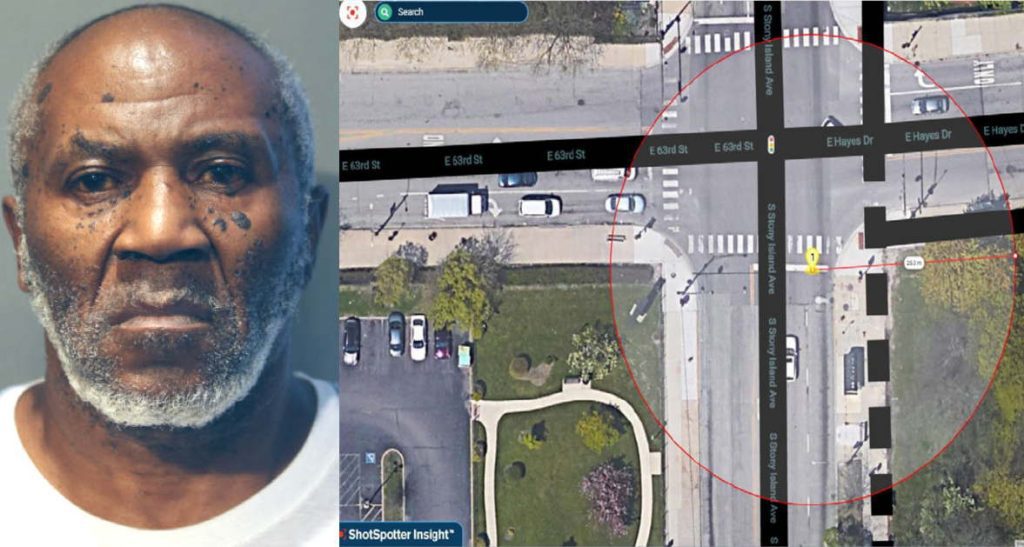
What happened next is the problem. Detectives spent three months building a murder case around that alert, arguing that Williams had fired the fatal shot himself, from inside the car, into the man sitting next to him.
The problem is that the city’s contract with ShotSpotter’s parent company, SoundThinking, included an explicit written warning that the system is not designed to accurately track gunshots fired inside an enclosed vehicle.
SoundThinking says what happened next is something the company rarely does.
“When the company learned that the prosecution’s theory depended on the assumption that the fatal shot was fired inside a car at extremely close range, we took the initiative to inform the Cook County State’s Attorney’s Office that ShotSpotter is not designed to detect gunfire within an enclosed vehicle, and that the prosecution’s in-car theory was not supported by the acoustic evidence,” the company said in a statement Friday.
Not long after, prosecutors dropped the charges. Williams walked out of jail having lost nearly a year of his life. SoundThinking says it believes its intervention is what turned the case around. The company was not named in Williams’ lawsuit.
This isn’t the first time the Williams case has been at the center of a ShotSpotter story that turned out to be more complicated than it first appeared.
In earlier coverage, multiple major outlets reported that a ShotSpotter engineer had moved the detected gunshot location more than a mile, from the 6300 block of South Stony Island Avenue to 5700 South Lake Shore Drive.
Anti-ShotSpotter advocates seized on the discrepancy as proof that the technology’s data could be manipulated at will.
SoundThinking’s explanation was considerably less dramatic.
The GPS coordinates of the gunshot, the company said, never changed. But when those coordinates were fed into a city database to create a street address, it kicked back a park district address on the opposite end of Jackson Park.
Several news organizations, including the Associated Press, found themselves publishing lengthy retractions.
Original reporting you’ll see nowhere else, paid for by our readers. Click here to support our work.
