
By Chief Tom Weitzel (Ret.)
Journalism’s primary obligation isn’t to validate a political narrative. It’s to tell the truth, especially when the facts are inconvenient.
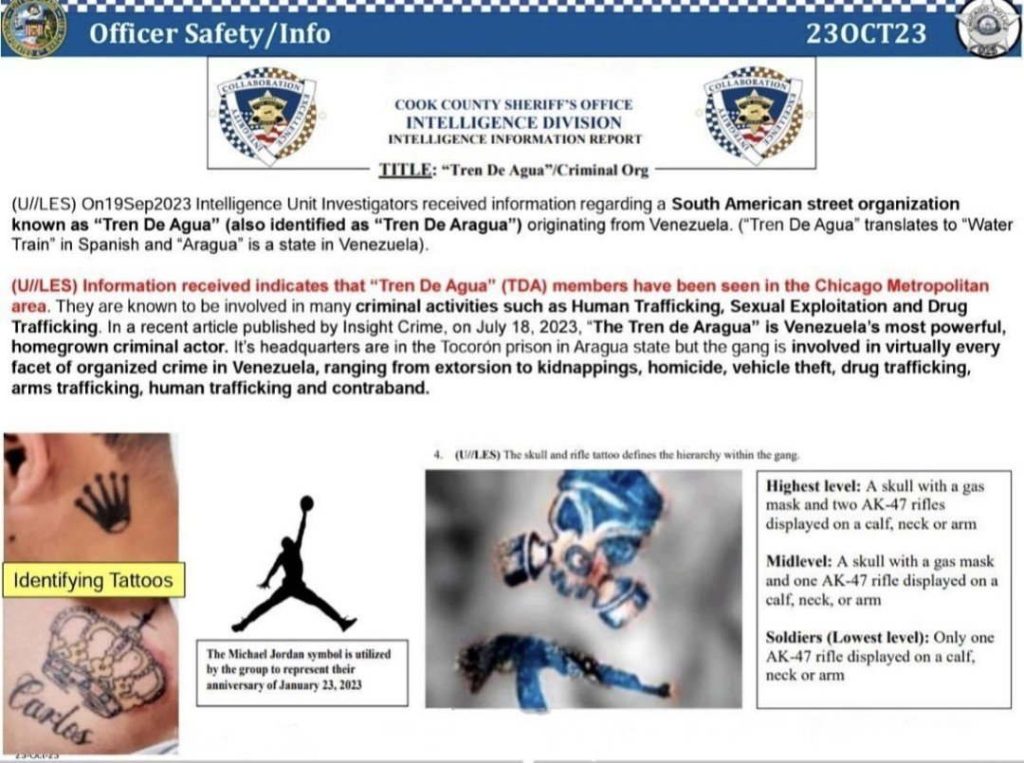
For over a year, many Chicago news outlets repeatedly questioned whether the Venezuelan criminal group Tren de Aragua had a real presence in Chicago or anywhere in Illinois. Readers were told the threat was exaggerated. TV reports and newspaper articles often suggested that law enforcement warnings were motivated more by politics than by evidence. Some commentators went even further, implying that concern about the gang’s presence was just election-year fearmongering.
The issue is that criminal investigations don’t follow political narratives. They follow evidence.
Today, the evidence is no longer merely speculative. It can be found in search warrants, detention petitions, guilty pleas, federal investigations, and criminal prosecutions filed in Illinois courts. The public record now shows that individuals identified by prosecutors as having connections to Tren de Aragua have operated in both Chicago and suburban Illinois.
CWB Chicago has documented a series of prosecutions involving defendants whom prosecutors identified as having ties to Tren de Aragua. One case alleges that gang members kidnapped an 18-year-old man from a Chicago park, beat him to death, shot him multiple times, abandoned his body, and then called his mother in Venezuela to tell her where he could be found. Those allegations remain to be proven in court, but they come from federal charging documents and prosecutors, not political campaigns or social media.
Another recent case involved a defendant identified by prosecutors as having ties to Tren de Aragua, who admitted selling firearms during an undercover investigation. In neighboring Will County, another defendant with alleged gang connections pleaded guilty in an unlawful gun sale case. These are not isolated internet rumors. They are criminal prosecutions in Illinois courts.
Yet where are the front-page stories acknowledging that earlier reporting underestimated the problem? Where are the editorials admitting that the evidence has changed? Instead, many of the same outlets that questioned the gang’s existence now report individual prosecutions without recognizing that those cases contradict months of dismissive coverage.
That is not just an editorial mistake. It influences public opinion. When citizens frequently hear that concerns raised by law enforcement are exaggerated, they start to distrust the officers, investigators, and prosecutors confronting these criminal organizations every day.
The consequences extend well beyond a single gang.
Public policy is increasingly shaped by narratives rather than evidence. Illinois lawmakers keep introducing laws that limit proactive policing, restrict investigative technology, weaken cooperation with federal agencies, and remove proven tools for fighting crime from local police departments. License plate readers, facial recognition, public surveillance cameras, and other investigative tools are seen as threats. Meanwhile, organized criminal groups continue using encrypted communications, stolen vehicles, false identities, and complex networks to avoid detection.
Reasonable people can debate how these technologies should be regulated. They cannot honestly debate whether they have solved murders, rescued kidnapping victims, dismantled gun trafficking organizations, and identified violent offenders. They have.
Good journalism requires skepticism toward government and law enforcement. Police should never be beyond scrutiny. However, skepticism must be applied consistently. It cannot become selective, accepting evidence only when it supports a preferred political view while dismissing evidence that challenges it.
When the facts change, responsible journalism adapts accordingly.
The people of Illinois deserve journalism that follows the evidence wherever it leads. They deserve reporters who are willing to admit when earlier assumptions are no longer accurate. Most importantly, they deserve an honest conversation about organized crime based on court records, criminal prosecutions, and documented investigations, not ideology.
Public safety relies on informed citizens. When the media downplays documented criminal activity because it conflicts with a preferred narrative, it does more than harm its own credibility; it also erodes public trust. It weakens the public’s ability to understand the threats facing their communities and the policies needed to address them.
That’s more than just poor journalism.
It’s a disservice to every law-abiding citizen who relies on the truth to hold both the government and the media accountable.

About Tom Weitzel
Tom Weitzel is a retired Chief of Police in Riverside, Illinois, and a longtime supporter of evidence-based policing and officer safety. He serves as a fellow with Awake Illinois and as an ambassador for the National Law Enforcement Officers Memorial Fund. Weitzel also sits on the advisory council for Citizens Behind the Badge, McLean, Virginia. He can be reached at [email protected].