
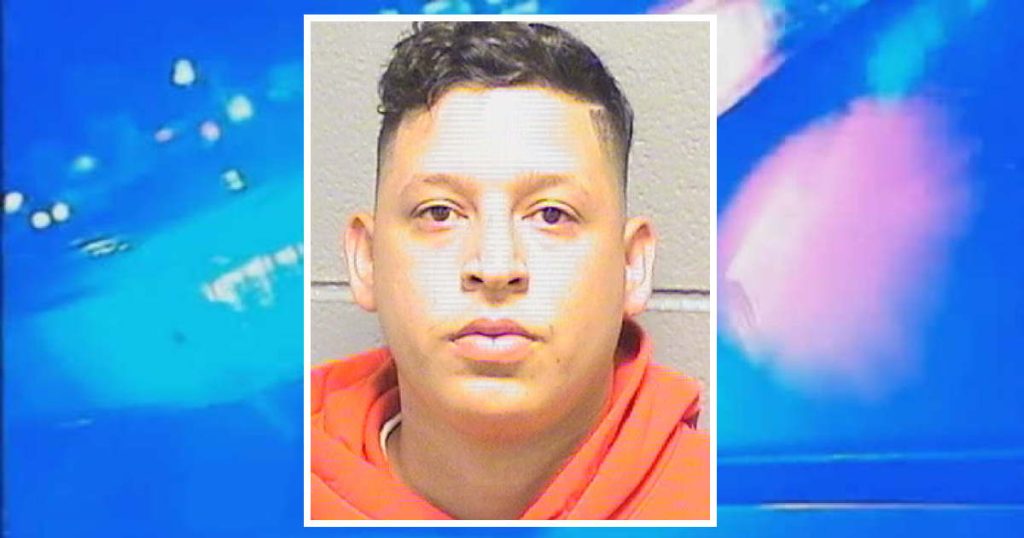
A Venezuelan man who prosecutors said had ties to the notorious Tren de Aragua gang received a five-year prison sentence this week after pleading guilty to state gunrunning charges stemming from an undercover federal investigation, court records show. Yefferson Camacho Cedeno, 28, pleaded guilty Wednesday, about a year after he was arrested in an undercover operation conducted by the federal Bureau of Alcohol, Tobacco, Firearms, and Explosives.
The investigation began in the spring of 2025, when an informant working with the ATF began working on a gun deal with a man. They ultimately agreed to meet in the 4900 block of South Wood Street in June 2025 to complete the sale of three handguns.
During the secretly recorded meeting, the man called his “associates” and told them to hurry up. Camacho Cedeno soon arrived in a vehicle carrying a plastic bag with a gun box inside, prosecutors said. He handed an undercover agent a 9mm pistol in exchange for $1,100, then sold a .380 pistol for $740 after the agent negotiated the price down from $750, according to prosecutors. The pair then completed the sale of another 9mm pistol for $760, along with several rounds of loose ammunition for $40. The agent had negotiated the price of the ammunition down from $100, officials said.
Prosecutors said Camacho Cedeno is a Venezuelan citizen who was “not a legal resident of the United States.”
Judge Thomas Byrne sentenced him to five years in prison and ordered him to serve 75% of the sentence. With credits earned in the Cook County Jail, Camacho Cedeno has about 2 years, 7 months remaining to serve.
The case was part of a broader federal investigation into suspected members and associates of the Venezuela-based Tren de Aragua gang, officials said at the time. Of the five people charged, Camacho Cedeno is the second to plead guilty.
Last month, CWBChicago reported that Jose Vasquez Hernandez, who prosecutors identified as an “associate” of Camacho Cedeno, received an 18-month prison sentence after pleading guilty to a state gun charge. But because of the time he spent in jail and a standard 50% sentence reduction, Vasquez Hernandez was released by the Illinois Department of Corrections the same day he arrived in their custody.
The investigation involving Vasquez Hernandez began in the spring of 2025, when an ATF informant arranged a gun deal near 16th Street and Homan Avenue, prosecutors alleged. Vasquez Hernandez showed up and identified himself as the other gun dealer’s “associate,” prosecutors said. He allegedly told the undercover agents and informant in Spanish, “I’m the other supplier, the one who gets these things.”
Vasquez Hernandez then led the group to a garage, retrieved a red bag and repeated, “I’m the one who gets this,” before producing a 5.56-caliber rifle and a 7.62-caliber rifle, according to prosecutors. He allegedly offered to sell the rifles for $3,800.
Prosecutors also alleged that Vasquez Hernandez discussed selling “Tusi,” a synthetic drug mixture sometimes referred to as “pink cocaine,” and said he could supply it. No drug transaction was completed, however, and Vasquez Hernandez was never charged with a narcotics offense.
When Cook County Judge Luciano Panici Jr. ordered Vasquez Hernandez detained last summer, he cited the allegation that Vasquez Hernandez was a “member of a transnational criminal organization” as one reason for keeping him in custody. Prosecutors also said he was a Venezuelan citizen who was “not a legal resident of the United States.”
Vasquez Hernandez’s post-prison freedom proved to be short-lived. Not long after CWB Chicago reported on his release from custody, federal agents arrested him on the streets of Chicago and began proceedings to remove him from the United States. A federal law enforcement agent told CWB Chicago at the time that authorities had not been notified by the county or state that Vasquez Hernandez was about to be released.
“He seems like the sort of person the government would like to have removed from the community,” the agent said. “Why make it difficult to remove someone everyone agrees should not be in our neighborhoods?”
Original reporting you’ll see nowhere else, paid for by our readers. Click here to support our work.
