
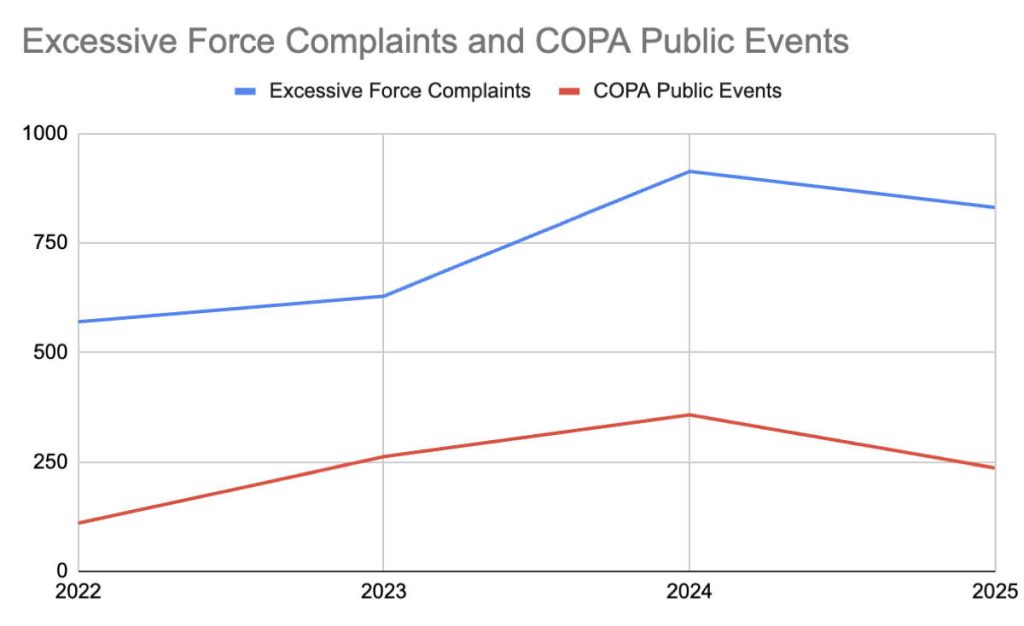
The WTTW headline was damning: “Excessive Force Allegations Against CPD Officers Rose 46% Since 2022: Data.”
How can it be that after all of these years of efforts to improve the city’s police department, there is still so much excessive force being deployed?
But allegations are just allegations. And WTTW’s report did not explore how many of those complaints were ultimately found to be valid. In fact, the outlet does not appear to have requested that data before filing its story. So, CWB Chicago did it for them.
As it turns out, the numbers look quite different once you filter for complaints that actually held up under scrutiny. The worst year for bona fide excessive force complaints in WTTW’s data set was 2022, and even then, the Civilian Office of Police Accountability sustained just 15% of cases.
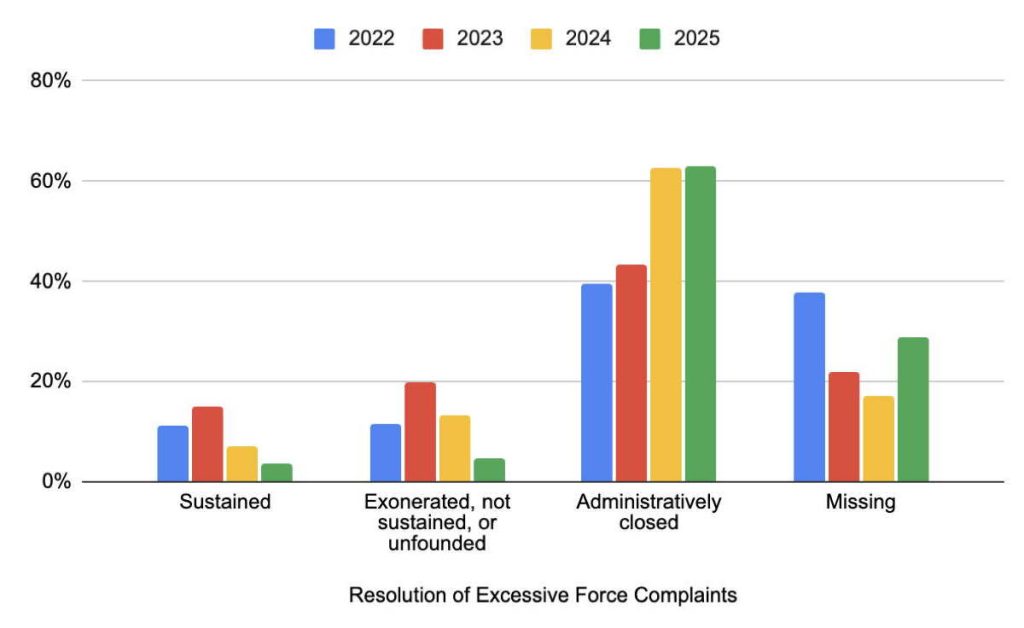
Last year, with more than 70% of cases already resolved, COPA sustained only 4% of excessive force complaints, a total of 30 cases. Of the 914 excessive force complaints filed in 2024, COPA has sustained 64. That’s 7%.
A significant driver of the rising complaint numbers appears to be an increase in cases that COPA classifies as “administratively closed.” These are matters resolved by senior COPA staff members, frequently because the person who filed the complaint does not follow through with investigators.
As for what is actually driving the surge in complaints, the picture is less clear. One possibility worth noting: The SAFE-T Act, passed in 2021, made it possible for people to file anonymous complaints against police officers in the state.
Another thought: COPA has dramatically expanded its presence at community events, spreading the word about what it does and how to file complaints and compliments. Such events ballooned from 110 in 2022 to 358 in 2024. It stands to reason, at least speculatively, that if more people know how to file complaints, more complaints will be filed.
It is also worth noting who paid for WTTW’s report. A funding disclosure at the bottom of the story states that “WTTW News coverage of policing and police reform is supported by The Joyce Foundation,” an organization that describes itself as one that invests in “evidence-informed public policies and strategies to advance racial equity and economic mobility for the next generation in the Great Lakes Region.”
The same funding source underwrote another WTTW policing story, headlined “A Chicago Man Was Charged With Murder Based on a ShotSpotter Alert. Now the City Will Pay Him $500K.”
What that story did not mention was that SoundThinking, ShotSpotter’s parent company, had actually intervened in that specific case after learning that CPD was using the technology in a manner its own contract with the city explicitly discouraged.
WTTW later updated its story to include a statement from SoundThinking, though its original framing remained largely intact.
CWB Chicago is funded by reader subscriptions and advertising. We do not accept grants or payments from political operations of any kind.
